

Biting down and feeling something hard. Running a tongue across a rough edge. Suddenly noticing a small piece of tooth that doesn’t belong there. You realize your have a chipped tooth. It happens more often than people think. Sometimes it’s a popcorn kernel. Sometimes it’s an accident during a weekend game of basketball. Other times, it’s just years of grinding or a large filling that finally gave way.
The good news? Most chipped or fractured teeth can be saved. We have excellent ways to restore them, often without needing a full crown.
What Actually Happens When a Tooth Breaks
Teeth are strong, but they aren’t invincible. A chip is exactly what it sounds like: a small piece of enamel breaking off the edge of a tooth. It might be barely noticeable, or it might feel sharp against the tongue.
A fracture goes deeper. It can run vertically through the tooth or involve the cusp (the pointy part of the chewing surface). Some fractures stay above the gum line. Others extend below it.
The treatment depends entirely on how deep the damage goes and which part of the tooth is involved. That’s why we always take an X-ray and do a careful exam before recommending anything.
The In-Between Option: Dental Onlays
When people hear about fixing a damaged tooth, they usually think of two things: a filling or a crown. But there’s a third option that’s often the best of both worlds.
An onlay is sometimes called a “partial crown.” Instead of covering the whole tooth like a crown does, an onlay covers just the damaged portion, usually one or more of the chewing cusps. They preserve more of your natural tooth structure than a crown does. They’re custom-made in a lab to fit perfectly. And they’re bonded directly to the tooth, which actually makes the remaining tooth stronger.
Onlays work beautifully for teeth with fractures that don’t extend into the root. They’re typically made of porcelain or composite resin, so they look completely natural.
When a Crown Is the Better Choice
Sometimes a fracture is too large or too deep for an onlay. If the damage wraps around the tooth or involves multiple surfaces, a crown provides better protection.
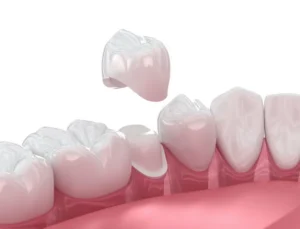
A crown fits over the entire visible part of the tooth like a snug hat. We first shape the tooth down slightly, then take an impression, and place a custom crown made of porcelain, ceramic, or another strong material.
Crowns are the go-to solution when a tooth has a large fracture, a previous large filling, or when the tooth is at risk of breaking further. They provide complete coverage and long-term durability.
Can Every Fractured Tooth Be Saved?
Here’s the honest answer: no, but most can be.
The teeth we cannot save are those with fractures that extend deep below the gum line or all the way down the root. In those cases, the tooth simply doesn’t have enough healthy structure left to hold a restoration. Extraction and replacement, often with an implant, becomes the best option.
But that’s not the typical scenario. Most chips and fractures stay in the crown (the part of the tooth you can see), and those are almost always fixable.
What to Do If You Chip or Fracture a Tooth
First, don’t panic. Rinse your mouth with warm water. If there’s any sharp edge, covering it with orthodontic wax or sugarless gum can protect your tongue and cheek.
Then give us a call. Even a small chip deserves a look. What seems minor today could turn into a bigger problem tomorrow if the tooth becomes more vulnerable to decay or further damage.
We’ll take an X-ray, examine the tooth, and walk you through your options. Sometimes a simple polish or small filling is all that’s needed. Other times, an onlay or crown is the right long-term solution.
Restore Your Bite and Smile Today
We’ve restored thousands of chipped and fractured teeth in our Media office. Chances are excellent that yours can be saved too.
To schedule an appointment, call us at 610.566.0291. We’re located at 47 State Road in Media, in the historic farmhouse where generations of local smiles have been cared for.